
AI and Leadership Development. Can AI Help Make Better Leaders?
For the past few years, most conversations about artificial intelligence in the workplace have focused on productivity. Organizations have been asking how AI can automate tasks, improve efficiency, reduce costs, and streamline processes. Those are important questions, but recent research suggests something else may be happening beneath the surface.
A recent Harvard Business Review article, How People Are Really Using AI in 2026, examined thousands of real-world AI use cases and found that many people are using AI for something quite different from simple automation. They are using it to think.
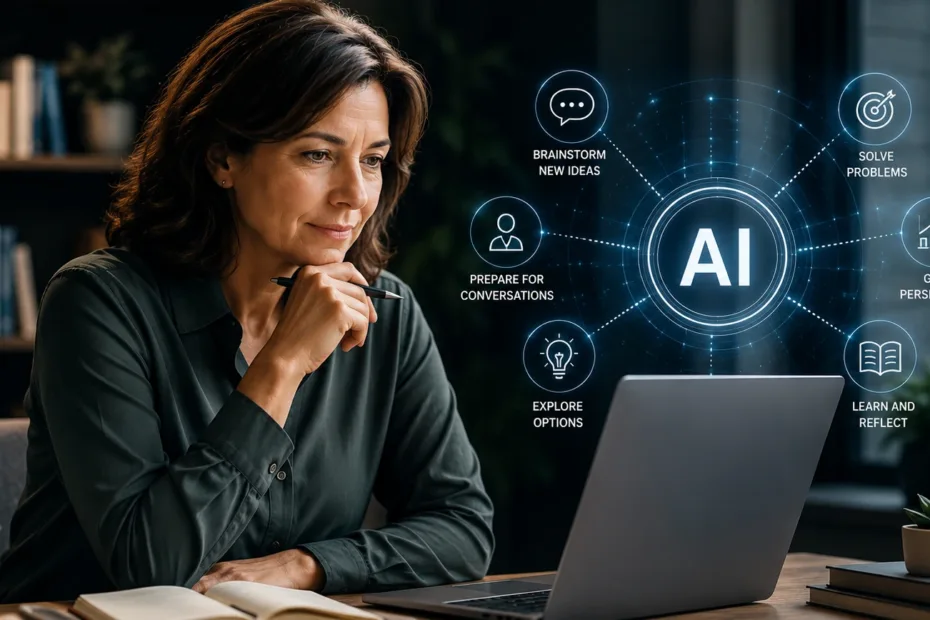
They are exploring ideas, preparing for difficult conversations, testing assumptions, and working through problems before taking action. For leaders, HR professionals, coaches, and learning practitioners, that shift in AI and leadership development may have significant implications.
Are Employees Using AI Differently Than Organizations Expected?
Much of the public discussion about AI focuses on technical applications such as content creation, coding, data analysis, and administrative support. While those uses continue to grow, the HBR research found increasing evidence that people are using AI as a sounding board.
Rather than simply asking AI to complete tasks, many users are engaging with it to explore questions, evaluate options, and gain perspective before making decisions.
This is particularly interesting because it reflects a very human need. When faced with uncertainty, people often seek a trusted source of input. Historically that might have been a manager, mentor, coach, colleague, or friend. Today, many people are adding AI to that list.
Whether organizations planned for it or not, employees are already experimenting with AI as a tool for reflection and problem-solving.
Why Are More People Using AI as a Thinking Partner?
The answer is surprisingly simple.
People frequently face situations where they need another perspective but do not necessarily have immediate access to one.
A manager may be preparing for a difficult performance discussion. An employee may be considering how to resolve a conflict with a colleague. A project leader may be weighing the risks of a major decision. In each case, AI provides a space to explore possibilities before engaging with others.
This does not mean the technology has become a substitute for human relationships. Rather, it appears to be serving as a form of preparation.
People are using AI to organize their thoughts, identify blind spots, generate ideas, and consider alternative approaches. In many cases, they are doing the same kind of thinking they might previously have done with a notebook, a mentor, or a trusted colleague.
The difference is that AI is available instantly and can respond interactively.
Can AI Make Leaders Better Prepared for Difficult Conversations?
One of the most intriguing implications of this growing maturity in the use of AI and leadership development involves real-time challenges for leaders.
At Synexe Consulting, we often discuss the conversations that shape the employee experience and influence performance, engagement, retention, and trust.
Examples include:
- Delivering performance feedback
- Coaching an employee through a challenge
- Discussing career growth opportunities
- Addressing workplace conflict
- Leading through organizational change
- Recognizing exceptional performance
These conversations rarely come with a script. Most leaders have experienced moments of uncertainty before entering an important discussion. They wonder whether they are approaching the situation correctly, whether they are missing something important, or how the other person might respond.
Used thoughtfully, AI can help leaders prepare for those moments. It can help them think through scenarios, refine questions, anticipate concerns, and consider different perspectives.
The technology does not conduct the conversation. The leader still must do that. However, better preparation often leads to better outcomes.
What Does This Mean for Leadership Development and Coaching?
For many organizations, leadership development has traditionally been delivered through workshops, courses, mentoring programs, and coaching engagements.
Those approaches remain valuable and necessary.
What may be changing is the ability for learning to occur continuously between formal development experiences.
A first-time manager may use AI to prepare for a difficult conversation before a coaching session. An employee may use it to reflect on feedback received from a supervisor. A project leader may use it to test communication strategies before presenting a recommendation to senior leadership.
In this way, AI has the potential to extend learning into the flow of work.
Importantly, this should not be viewed as a replacement for coaching. Effective coaching relies on trust, accountability, experience, empathy, and context. Those elements remain uniquely human.
Instead, AI may become a complementary tool that helps individuals reflect, prepare, and learn more consistently between coaching interactions.
Will AI Replace Human Judgment in the Workplace?
This is perhaps the most important question organizations should be asking.
The answer is no, but it can influence how judgment is developed and exercised.
Leadership has never been about having perfect answers. It is about making informed decisions in complex situations where competing priorities, relationships, emotions, and organizational realities must all be considered.
AI can contribute valuable perspectives, but it cannot fully understand organizational culture, team dynamics, trust, history, or human emotion. Those factors remain essential components of effective leadership.
There is also a legitimate concern that overreliance on AI could weaken critical thinking. If employees accept AI-generated recommendations without questioning them, they risk becoming less analytical and less independent in their decision-making.
Organizations should encourage employees to use AI as an input, not as a substitute for judgment.
The goal is not to delegate thinking to technology. The goal is to improve the quality of thinking before decisions are made.
AI and Leadership Development – How Should HR and Learning Leaders Respond?
As AI becomes increasingly integrated into daily work, HR and learning leaders have an opportunity to shape how it is used.
Rather than focusing exclusively on policies and restrictions, organizations should help employees develop the skills needed to use AI responsibly and effectively.
These skills include:
- Critical thinking
- Asking better questions
- Evaluating information sources
- Identifying bias and inaccuracies
- Ethical decision-making
- Communication and influence
- Reflective practice
In many respects, these are the same capabilities that have always been associated with effective leadership.
The difference is that AI is making them more important than ever.
What Will Separate Successful Organizations from the Rest?
The organizations that gain the greatest advantage from AI will probably not be the ones with access to the most sophisticated technology.
Most organizations will have access to similar tools.
The real differentiator will be how effectively they help their people use those tools.
Organizations that invest in leadership development, coaching, communication skills, critical thinking, and human-centered management practices will be better positioned to benefit from AI than those that focus solely on automation.
Technology can provide information and insight. It can help people prepare, reflect, and learn.
Leadership, however, still happens through conversations, relationships, trust, and judgment.
Those remain fundamentally human capabilities.
The findings from Harvard Business Review’s research suggest that AI may become one of the most valuable preparation tools leaders have ever had. The organizations that succeed will be those that recognize the difference between using AI to replace human thinking and using AI to improve it.
Frequently Asked Questions
How are employees using AI in the workplace?
Recent research suggests employees are increasingly using AI for brainstorming, problem-solving, decision support, learning, coaching preparation, communication planning, and reflection, in addition to traditional productivity tasks.
Can AI replace leadership coaching?
No. AI can support preparation and reflection, but it cannot replace the empathy, accountability, trust, and human connection that effective coaching provides.
What role should HR play in AI adoption?
HR leaders should help employees develop responsible AI usage skills, including critical thinking, ethical decision-making, information evaluation, and effective communication.
What leadership skills become more important in an AI-enabled workplace?
Critical thinking, emotional intelligence, communication, adaptability, judgment, coaching, and relationship-building become increasingly valuable as AI takes on more routine tasks.
Reference
Zao-Sanders, M. (2026). How People Are Really Using AI in 2026. Harvard Business Review.
If you’re ready for practical, human-centered leadership development, send us a quick note or connect with us on LinkedIn.